AI writes the software. A person signs it.
How to bring artificial intelligence into company software with speed, control and accountability.
A person asks.
It all starts there.
“The AI did it” is not an answer.
In front of a customer, an auditor or a board, someone must be able to say: I verified it myself.
Software written by AI enters the company faster than people can understand it. Meanwhile the application estate ages: frameworks out of support, known vulnerabilities.
-
FOMO
The fear of falling behind
A new model every week, competitors announcing. The fear is legitimate: what matters is what you let it do.
The model changes, your knowledge stays.
The new model comes in and inherits your rules, your Skills, your checks. From the next day it works inside them.
-
Shadow AI
AI used out of sight, outside the rules
If the official road is slow, haste takes the short one: company data in external chats, code written by AI without saying so.
You know which model works, and on which data.
The company decides which models, for which data: ordinary data in the cloud, sensitive data on a model in your own house. Every choice stays on record.
-
Comprehension debt
Software grows faster than those who understand it
The code builds and the tests pass, but nobody can explain why it works any more. You gain speed, you lose control.
Every signed decision becomes a rule.
What a person approves today is written, versioned and applied tomorrow: the knowledge stays with the company, not in a few heads.
You don’t answer haste by slowing AI down, nor by running blind: you answer it with a governed process.
AI works.
Inside six checks.
From these three answers comes Haicor, with LOOM at the centre.
LOOM is the engine that makes them real: six checks on every request, with any model. And each one leaves a proof.
- Accesswhoever asks is authorised to
- Rulescompany rules, before the model works
- Knowledgethe right Skills, put in context
- Workthe model proposes; what has effects waits
- Checkthe answer is verified before it leaves
- Proofevery step stays on record
Registerrequest 1842 · from Coding
Names and data are illustrative.
Today anyone can write code. Quality, not so.
The difference is not the tool: it is the experience of those who know how, which no longer stays in a few heads.
| Anyone, with an AI tool | An expert team, inside Haicor | |
|---|---|---|
| Time | Short. | Short: the same speed advantage. |
| Competence | That of whoever writes the request, that day. | That of the team, written in the Skills and applied to every request. |
| Checks | Those the author remembers to run. | Automated, the same for everyone, at every step. |
| Who answers | “The AI did it.” | An expert person, who verifies and signs. |
For the software of large companies and public bodies it is not a choice: you need a human signature and knowledge of what the AI did.
The model changes. The rules stay.
A new model every week: which one to pick? With Haicor the model is a component. Pick it for quality and cost, per module, per session, even per phase. And swap it without starting over.
Commit to the method, not the tool.
- Policies
- Skills
- Checks
- Audit
inherited from day one
A person verifies.
And signs.
Why reading every line is not enough, and does not scale.
Whoever reads every line becomes the bottleneck: control moves to the rules, and to the signature on the result.
What gets counted
- Faithful to analysis and requirements
- Within company standards
- Commented, with their tests
- Passing build and quality checks
The person does not read everything the same way: they decide the rules, read where the risk is high, sign the result.
Estimates for Java/Spring with frontier models and a single agent; with other stacks and models the ranges change. These are not measurements: they are calibrated in the pilot, on your code.
The machine proposes, a person decides.
- The machine checks the form
- Build, tests, stop rules, archived evidence.
- The person checks the substance
- Goal, irreversible choices, and a signature with name and role.
Nothing reaches production until a person has verified it, understood it and signed it.
The signature is what counts, not re-reading every line. A signature alone does not guarantee quality: it means someone answers for it, evidence in hand.
Five web applications, three desktop tools, one method.
They are not steps in a sequence: adopt them one at a time or together, in the order your company needs.
Know your application estate before deciding.
From facts to strategy: inventory, features, estimates and remedies, then a person validates.
What stays: Dossier, risks, roadmap
The page for Analysis →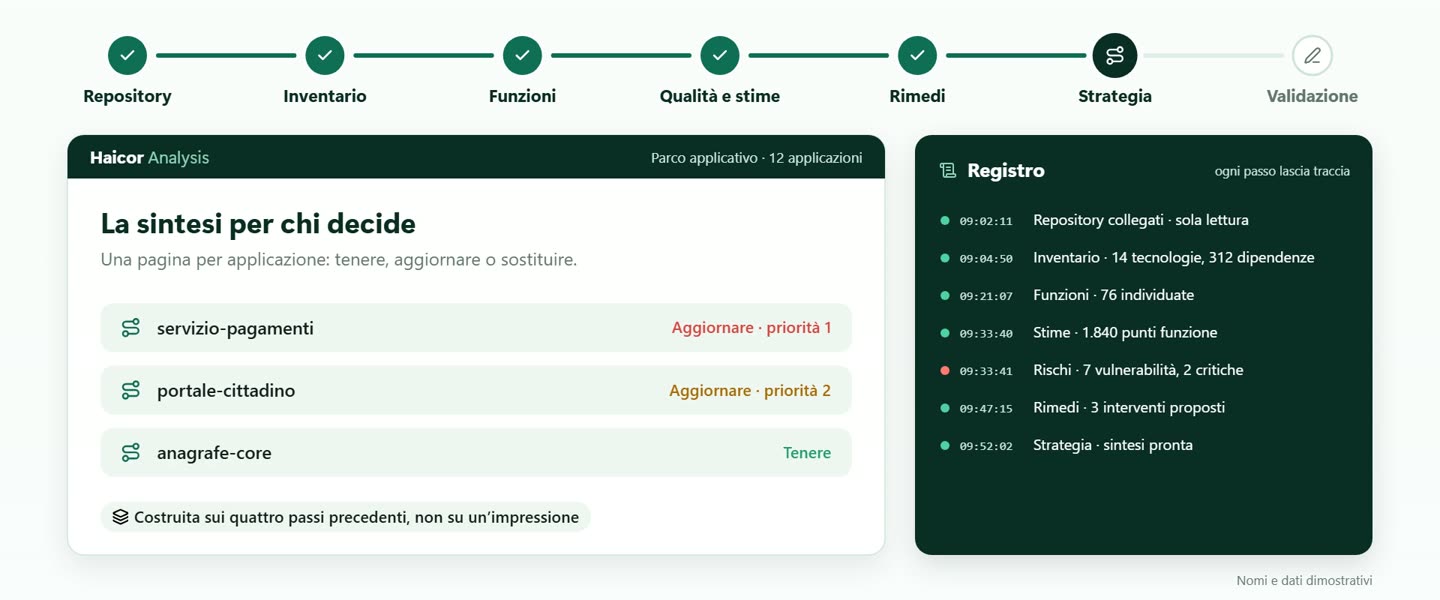
From idea to branch, with changes approved one by one.
From blueprints to commit: project, design, request, tests and approval.
What stays: Approved code, on the branch
The page for Coding →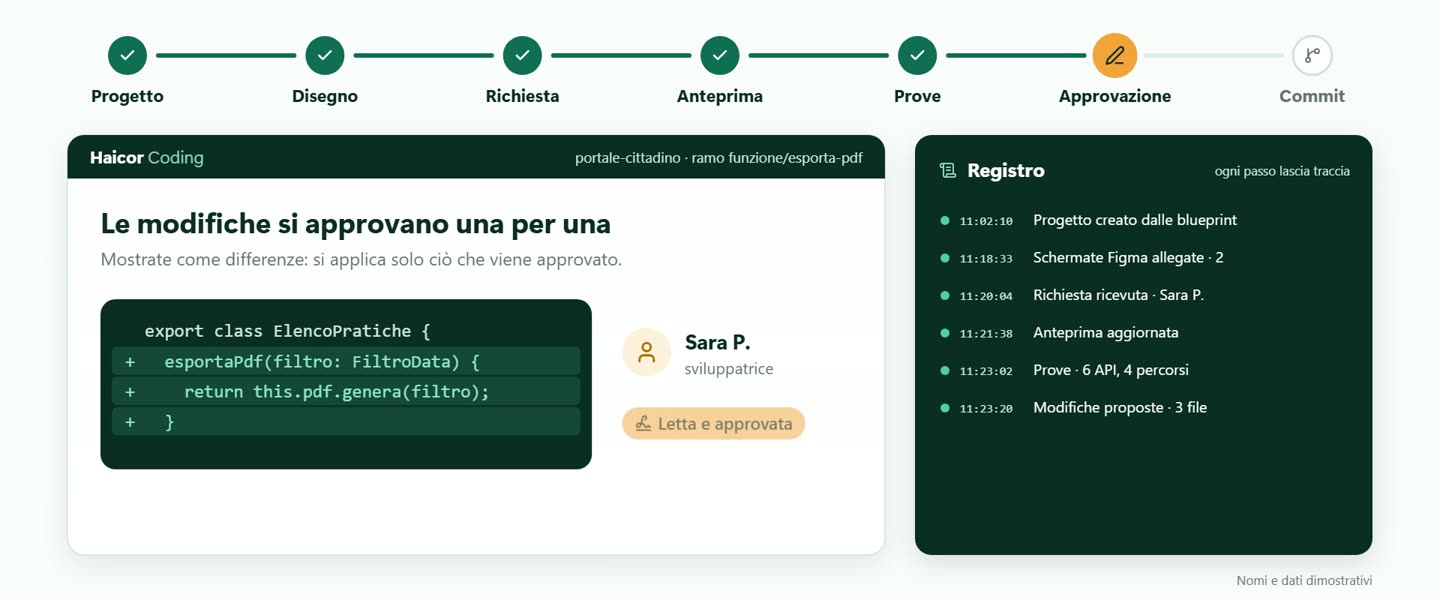
Vulnerabilities fixed one file at a time, and approved.
Every fix has its reasoning: the specialist reads it before approving.
What stays: Change proposal with the evidence
The page for Fixing →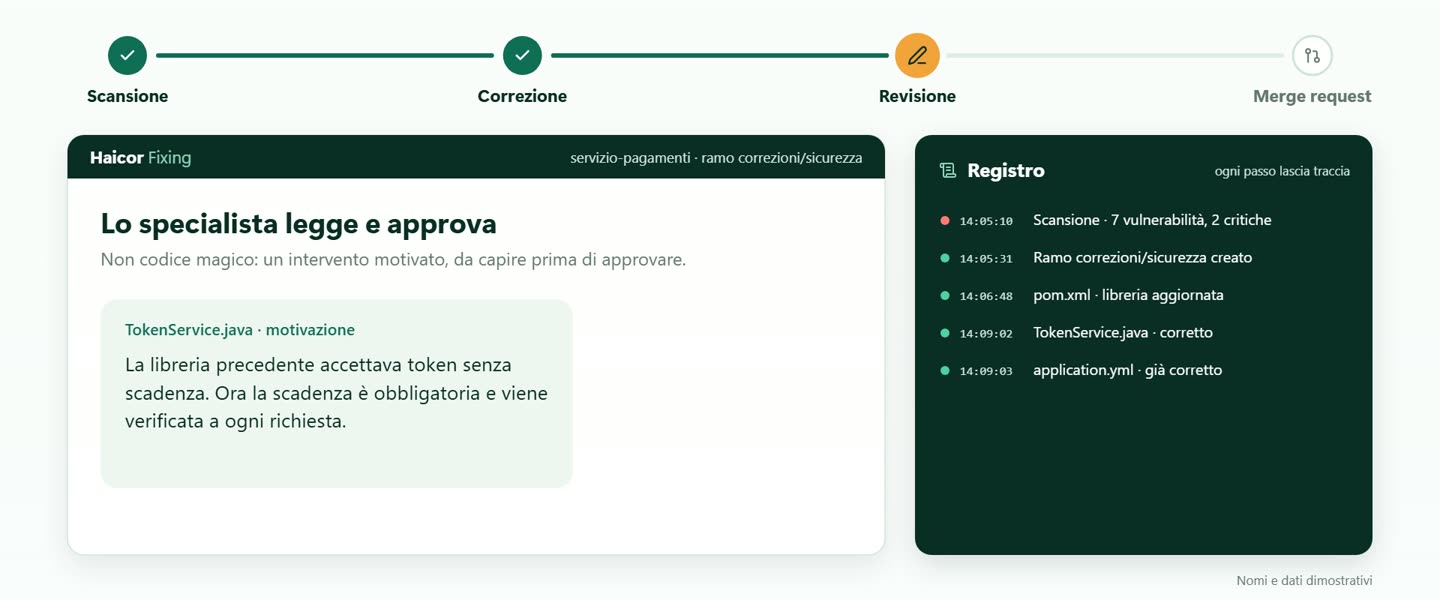
The chat everyone already uses, inside company rules.
The answer to Shadow AI: same convenience, no data outside, sources to check.
What stays: Conversations and sources in house
The page for Chat →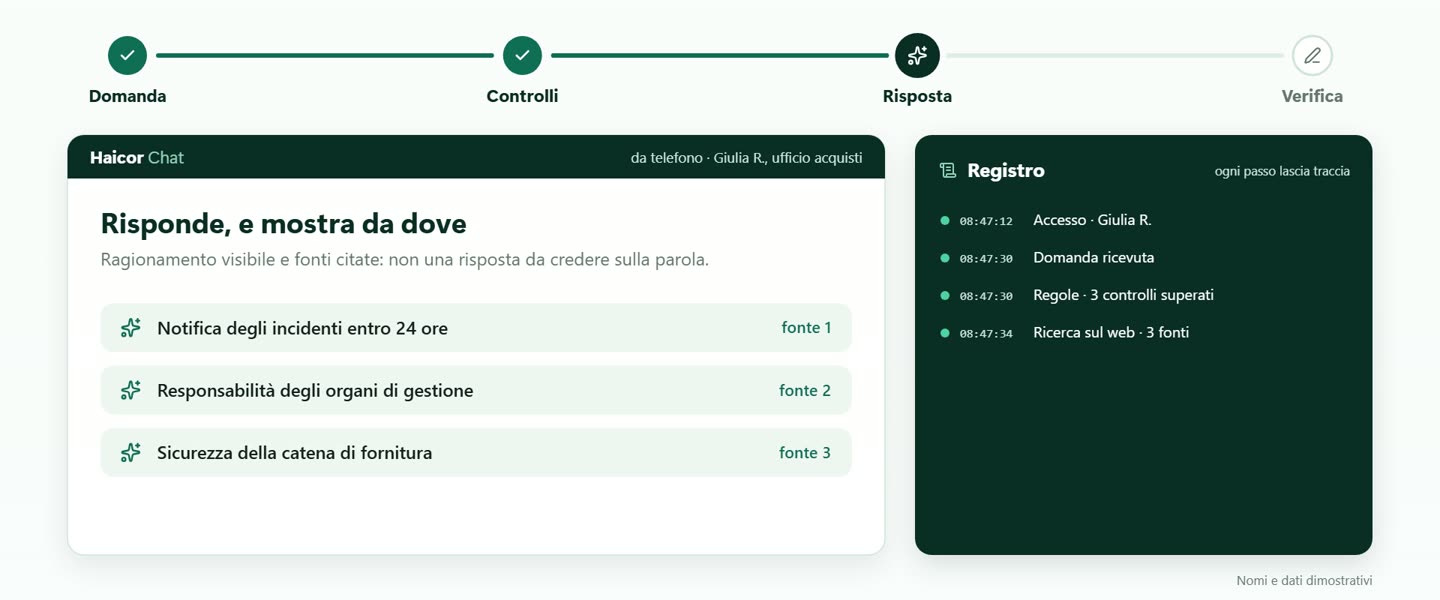
Rules are written once, and applied by everyone.
Every change is a version; it is published after an approval.
What stays: Versioned rules, owned by the company
The page for Skill →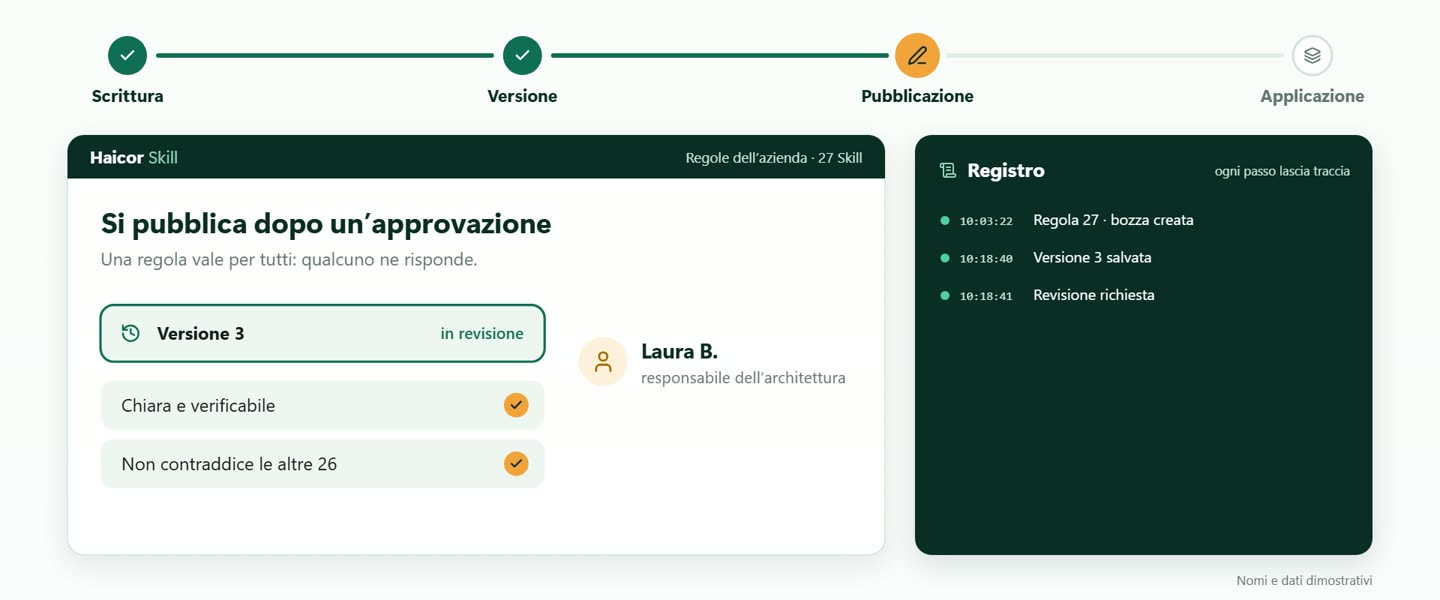
Three tools on the developer’s machine, one flow.
Probe measures, Shift ports, the CLI refines: a person decides, and what is learned goes back to LOOM.
What stays: The starting facts
The page for Probe →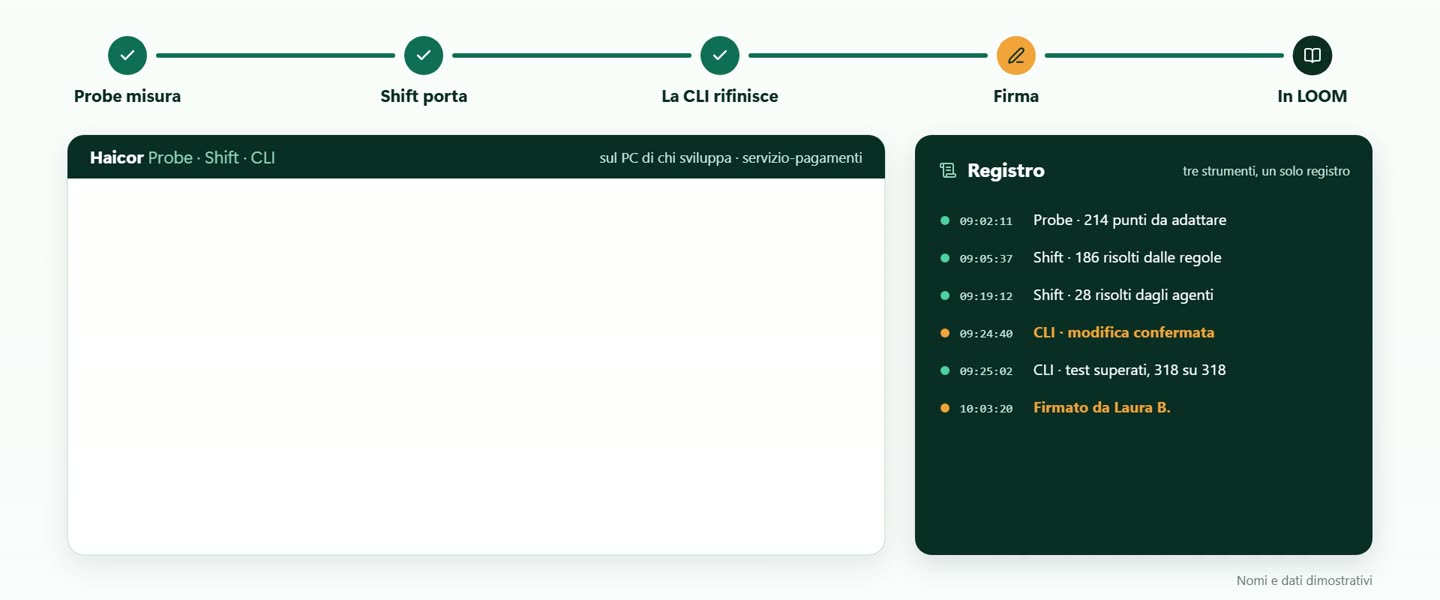
Port frameworks, with no blind releases.
Rules solve what is repeatable, agents the rest; only what builds and passes the tests is consolidated.
What stays: Signed application
The page for Shift →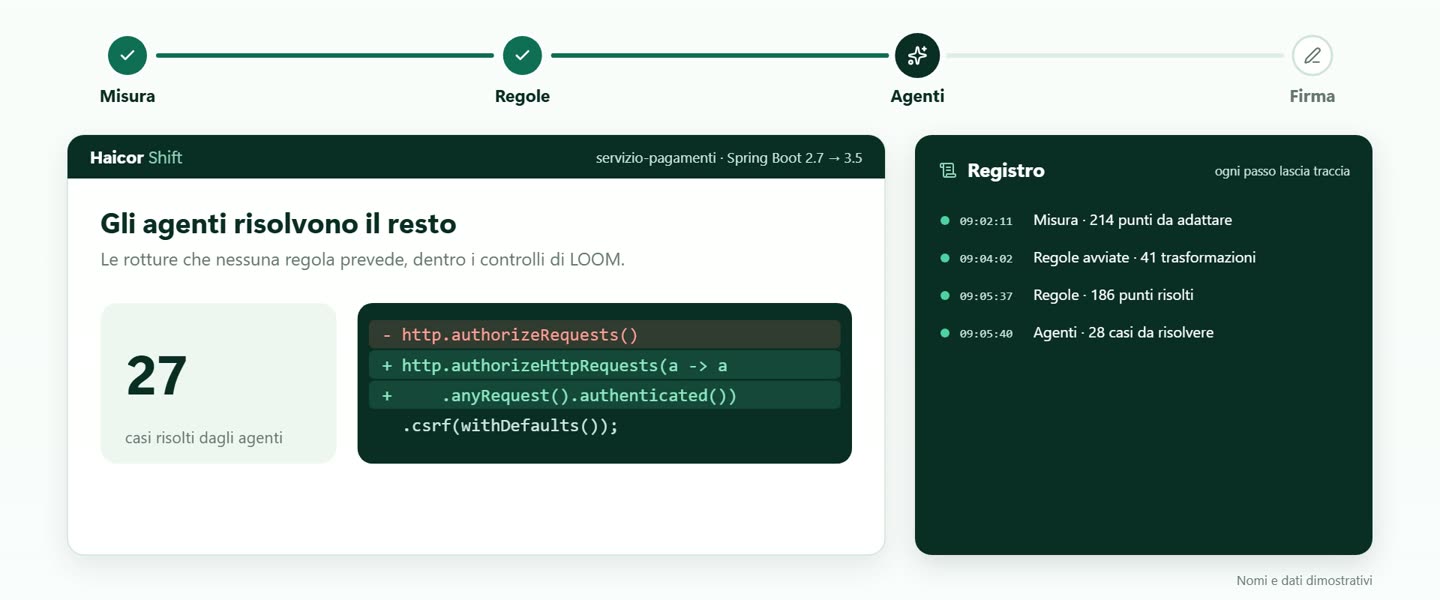
AI in the terminal, under the same rules.
Every action with effects asks the developer for confirmation before it happens.
What stays: The same rules everywhere
The page for CLI →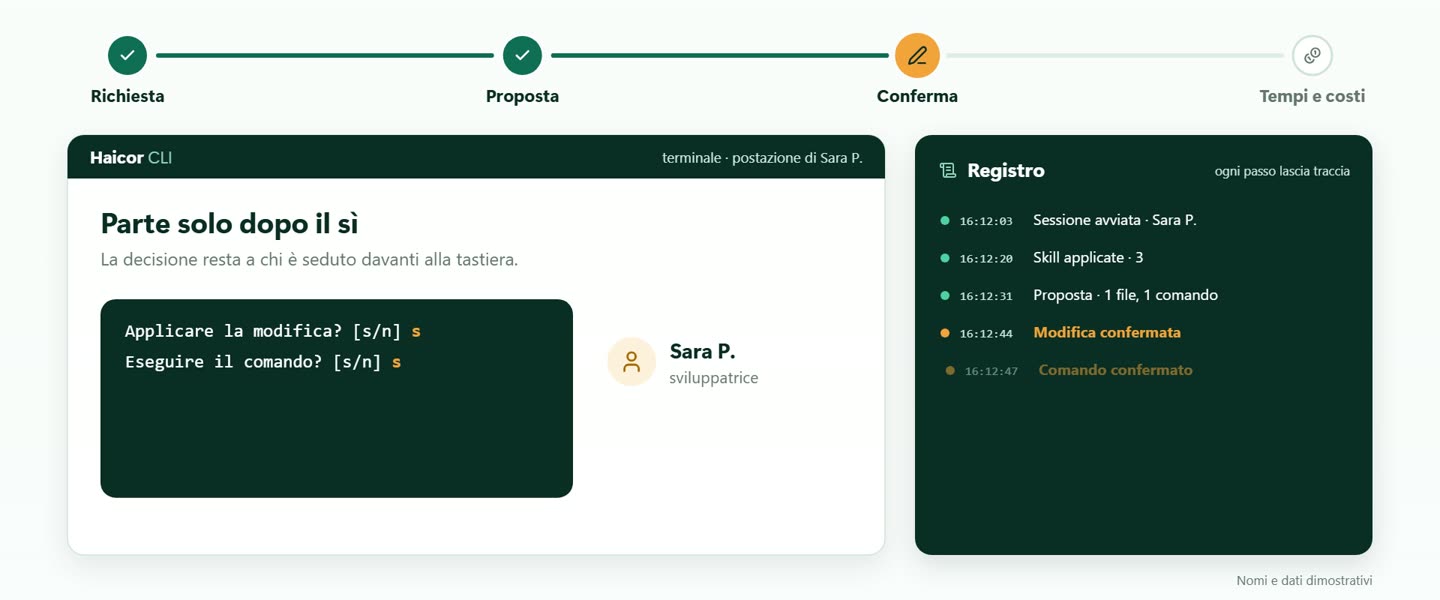
Where a person decides
- Analysisvalidatesthe artifacts
- Codingapprovesthe changes
- Fixingapprovesthe fixes
- Chatverifiesthe sources
- Skillapprovesthe rule
- Shiftsignsthe result
- CLIconfirmsthe actions
Platform services
- Platformsingle entry point to the applications
- Adminusers, models, costs
- Hubwhere the tools are downloaded from
In common: LOOM applies the rules, Skills accumulate, a person signs.
Haicor is built on your technologies, not the other way round.
- Stack
- Blueprints and Skills on your standards; if the stack changes, Haicor follows.
- Tools
- Same repositories, same pipelines, same company login.
- Infrastructure
- On-premise in your data centre, or dedicated SaaS.
How we start: on your code.
A demo
We show the full cycle on a case close to yours: request, agents, checks, signature.
A pilot assessment
Analysis on a real application from your portfolio. The real numbers come from there.
Your own Haicor
A dedicated installation, shaped on your stack and your rules. It can even have its own name, chosen with you.
Could you answer them, today?
These are the questions we asked ourselves. Mark the ones your organisation could answer with evidence.
-
Who answers, today, for the software AI has written for you: what you buy and what your people generate?
-
If a customer, an authority or an auditor asked how a result was produced, could you reconstruct it?
-
How many irreversible choices, on data, architectures and processes, were made by a tool in recent months, without a signature?
-
If AI were unavailable tomorrow, how much of your software could you still explain, and change safely?
-
Which of your rules are written so that a machine can respect them? And which live only in someone’s head?
-
When you change AI vendor, and you will, what will be left in your hands?
Questions, not answers.
Let’s talk →Endow: since 2010, software for public bodies and large companies.
Haicor was born in our Innovation Garage, from the experience of more than a hundred projects.
CertificationsUNI EN ISO 9001ISO/IEC 27001Legality RatingGender equality
AI is fast.
HI is rightArtificial Intelligence · Human Intelligence
Speed belongs to AI. Accountability stays with a person.
The next step: A demo on your code, or a pilot assessment on an application of your choice.